

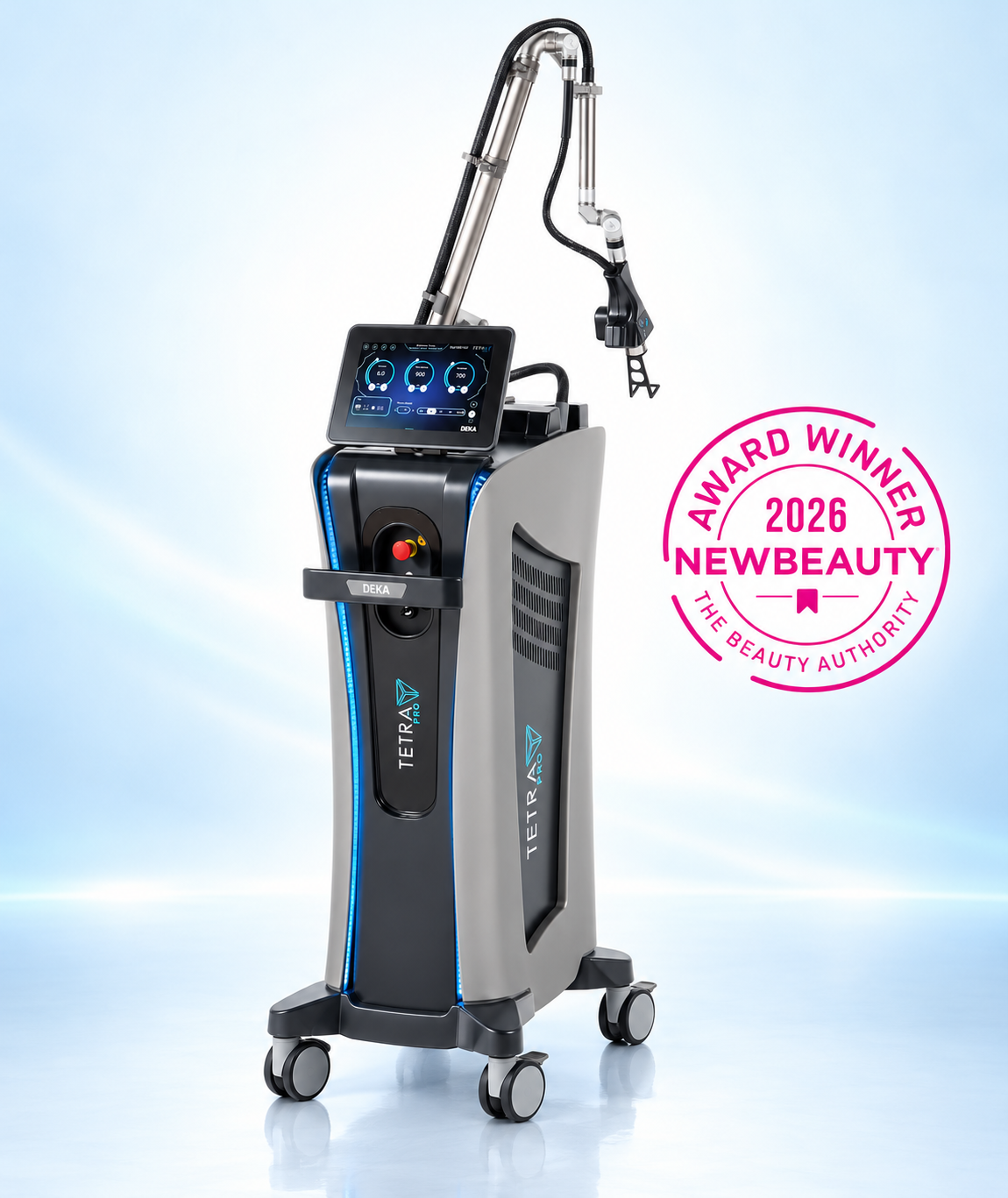
CoolPeel is a customizable fractional CO₂ resurfacing approach performed with the Tetra PRO platform. It can be planned at a lighter intensity to limit unnecessary thermal spread and shorten visible recovery for appropriate patients. That does not make it risk-free, “non-ablative,” or automatically suitable for every skin type or concern.
The short version
The device provides options. The plan determines the experience.
Two people treated with the same platform can receive very different settings, coverage, passes, preparation, and aftercare. The most responsible comparison is therefore not CoolPeel versus “all CO₂,” but a specific treatment plan versus another plan for the same person and goal.
How fractional CO₂ resurfacing works
Carbon-dioxide lasers emit light at 10,600 nm, a wavelength strongly absorbed by water in tissue. When energy is delivered in small fractional columns rather than uniformly removing the entire surface, treated microzones are surrounded by untreated skin. The clinical intent is controlled ablation and thermal effect followed by re-epithelialization and remodeling.
The FDA 510(k) summary for SmartXide Tetra PRO describes a Class II, 40-watt CO₂ surgical laser that delivers energy through an articulated arm and compatible accessories. A 510(k) decision establishes substantial equivalence for the cleared device; it is not a guarantee of a particular cosmetic result for an individual patient.
Fractional delivery does not erase the tradeoff between effect and recovery. Deeper ablation, greater density, longer dwell time, overlapping passes, and more thermal diffusion can increase tissue response—and can also increase redness, swelling, crusting, pigment alteration, infection risk, or prolonged healing. Appropriate settings depend on anatomy, indication, skin type, recent sun exposure, health history, and the patient's recovery tolerance.
What is different about the CoolPeel approach?
DEKA positions Tetra PRO as a platform with pulse-shape and scanning controls intended to deliver CO₂ energy efficiently. CoolPeel generally refers to a treatment strategy that uses short pulses and selected coverage to create superficial fractional injury while limiting excess heat accumulation. The practical aim is meaningful resurfacing with a recovery profile that may fit patients who do not want a more aggressive CO₂ procedure.
“Cool” does not mean the skin remains cold, and “Peel” does not mean every patient will visibly peel. Warmth, redness, a dry or sandpaper-like texture, bronzing, flaking, swelling, and sensitivity can occur. Recovery varies with settings and individual response.
Tetra PRO can also support treatment plans other than a light CoolPeel. That flexibility is valuable, but it makes accurate language important: claims about a lighter protocol should not be generalized to every CO₂ setting available on the platform.
What does current evidence support?
Fractional ablative CO₂ laser has a substantial clinical history for photoaging, texture, wrinkles, and selected scar concerns. A 2023 clinical review summarizes evaluation, techniques, outcomes, and potential complications for facial CO₂ rejuvenation. A 2025 expert consensus—based on questionnaires completed by 21 dermatologists and plastic surgeons—offers practical recommendations on patient selection, infection prevention, anesthesia, settings, and aftercare.
The consensus is useful but has limits: it reflects a relatively small expert panel, focuses partly on a specific device context, and several contributors disclosed industry relationships. It is guidance, not proof that one protocol is best for every patient.
A 2024 split-face study of a faster fractional CO₂ scanner included 12 women with fine lines. The authors reported shorter treatment time and assessed coverage, pain, side effects, and improvement. The sample was small, and several authors were affiliated with the device manufacturer. It supports continued study of pulse and scanner design, not a universal promise of faster healing or superior results.
Evidence boundary
Platform claims and general CO₂ evidence are not interchangeable.
Research on fractional CO₂ resurfacing helps explain the treatment category. It does not automatically validate every branded setting, marketing phrase, combination treatment, or downtime claim. Individual protocols should be discussed with the treating clinician.
What recovery may look like
Immediately after treatment
The skin may look and feel warm, pink, tight, or mildly swollen. Your clinician should provide instructions for cleansing, moisturizing or occlusive care, sun avoidance, and when to resume active skincare. Do not add acids, retinoids, exfoliants, or fragranced products simply because the treatment was marketed as light.
Over the next several days
Redness may persist, and a rough or dry texture, bronzing, pinpoint crusting, flaking, or temporary sensitivity may develop. Makeup timing and product use should follow the specific post-care plan. Picking or scrubbing can disrupt healing.
When to contact the clinic
Contact the treating practice promptly for increasing pain, spreading redness, pus, fever, blistering, unusual swelling, a cold-sore outbreak, eye symptoms, or any reaction that feels more severe than expected. Emergency symptoms require urgent medical care.
Who needs a more cautious assessment?
Active infection, open wounds, recent significant sun exposure or sunburn, impaired healing, certain medications, a history of abnormal scarring, pregnancy or breastfeeding considerations, and active inflammatory skin disease may affect timing or candidacy. A history of herpes simplex may change preventive planning.
Skin tone and pigment history matter. Post-inflammatory hyperpigmentation can occur after laser injury, particularly in patients predisposed to pigment change. Melasma also requires care because heat, inflammation, hormones, and ultraviolet or visible light can influence recurrence. A treatment designed for texture should not be casually presented as a guaranteed melasma solution.
Patients in Bellevue and across the Seattle Eastside should also plan around seasonal sun exposure, outdoor travel, skiing, and summer activities. Consistent sun protection and realistic scheduling are part of treatment—not optional extras.
Bellevue · Seattle Eastside
Choose the plan,
not just the device name.
A Muse MedSpa consultation reviews your concern, skin history, pigment response, desired recovery window, and alternatives before recommending a CoolPeel or another resurfacing approach.
Common questions
What patients often ask
Is CoolPeel a CO2 laser treatment?
Yes. CoolPeel is a treatment approach delivered with DEKA's 10,600 nm carbon-dioxide laser technology. The treatment plan, pulse mode, density, energy, and number of passes are selected by the treating professional rather than being identical for every patient.
Does CoolPeel have no downtime?
No procedure can guarantee zero downtime. Many people choose a lighter CoolPeel plan because recovery may be shorter than with more aggressive fully ablative CO2 resurfacing, but redness, warmth, dryness, swelling, bronzing, rough texture, peeling, or temporary sensitivity can still occur.
What concerns may be discussed during a CoolPeel consultation?
A consultation may address texture, fine lines, visible pores, uneven tone, photodamage, or selected acne-scar concerns. Whether CO2 laser is appropriate depends on the concern, skin type, medical history, recent sun exposure, medications, healing history, and acceptable recovery time.
Is CoolPeel safe for every skin tone?
No single laser protocol is automatically appropriate for every skin tone. Fractional CO2 treatment can carry a risk of post-inflammatory pigment change, and settings and preparation may need modification. An in-person assessment is essential, especially for patients with a history of hyperpigmentation or melasma.
How many CoolPeel sessions will I need?
There is no universal number. A lighter plan may be performed as a series, while a more intensive plan may require a different schedule and recovery window. Your clinician should match the plan to the concern and response rather than promise a fixed result.
Can I schedule CoolPeel immediately before an event?
Usually it is better to allow a buffer. Even a lighter treatment can cause visible redness, roughness, peeling, or swelling. Tell the clinician about travel, photography, weddings, and other deadlines so timing can be planned conservatively.
Sources and further reading
- DEKA: Tetra PRO official product information, accessed November 9, 2026.
- U.S. FDA 510(k) database: SmartXide Tetra PRO, K240497.
- U.S. FDA 510(k) summary: SmartXide Tetra PRO.
- Expert consensus on clinical recommendations for fractional ablative CO₂ laser in facial rejuvenation, Lasers in Surgery and Medicine, 2025.
- Carbon dioxide laser rejuvenation of the facial skin, Facial Plastic Surgery Clinics of North America, 2023.
- A faster CO₂ fractional scanner system mode for skin rejuvenation: a clinical study, Skin Research and Technology, 2024.
This article is general education, not medical advice, diagnosis, or a guarantee of results or downtime. Individual results and treatment experiences vary. A qualified medical professional should assess candidacy, risks, benefits, alternatives, settings, and aftercare.