

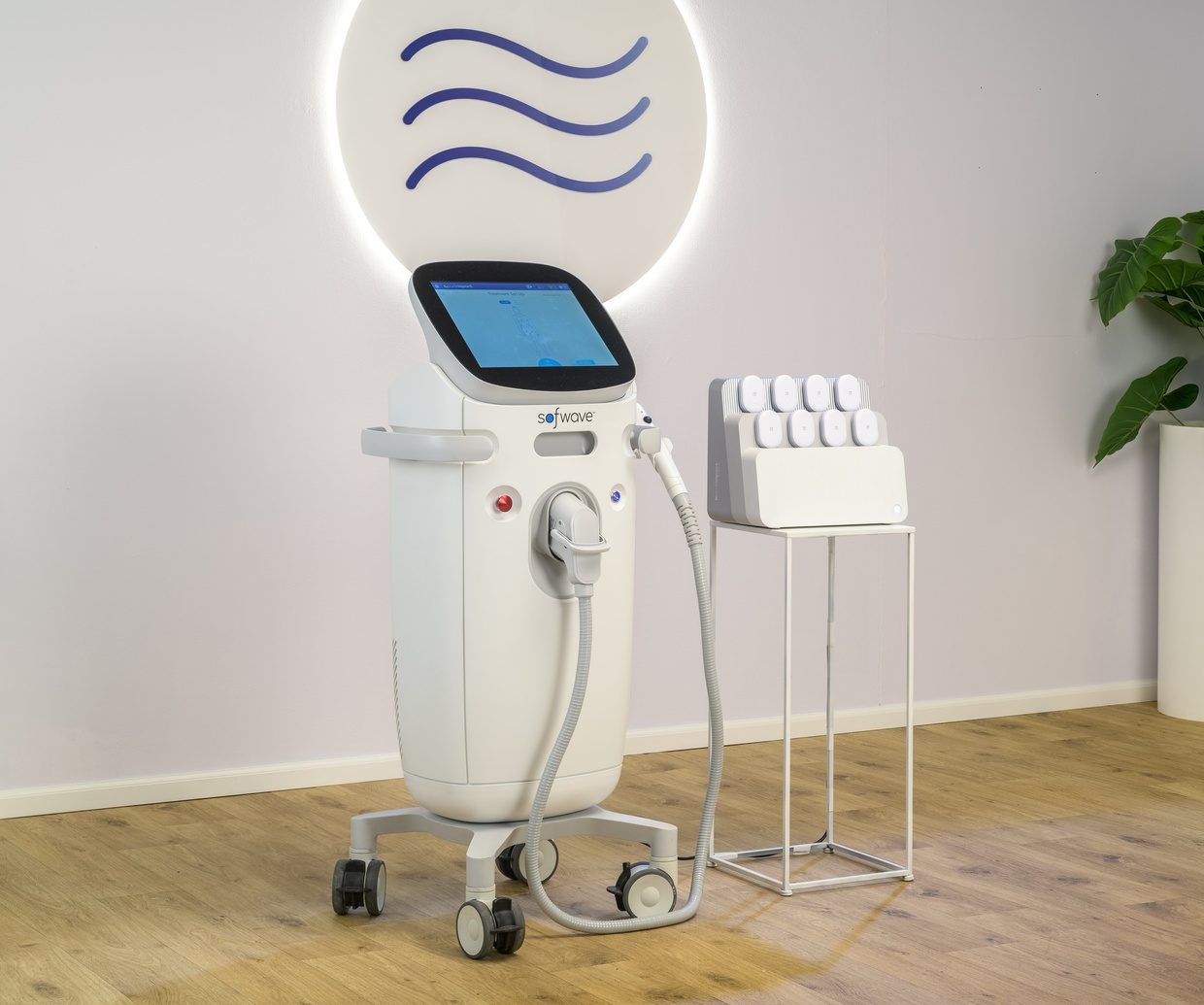
Skin laxity is not a single-layer problem. Collagen organization, elastin, facial movement, volume change, sun exposure, and time all influence what we see in the mirror. That is why it is helpful to understand exactly which layer a device is designed to reach—and why one treatment cannot address every cause of facial aging.
What is Sofwave, scientifically?
Sofwave uses a form of high-intensity, high-frequency, non-focused ultrasound called Synchronous Ultrasound Parallel Beam, or SUPERB™ technology. Rather than focusing ultrasound into a deep single point, the handpiece delivers parallel beams that create controlled thermal zones in the mid-dermis. Published reviews describe the target depth as approximately 1.5 millimeters.
The biological rationale is controlled dermal heating. Heat can partially denature existing collagen and initiate a wound-healing response associated with new collagen and elastin formation. The device also uses integrated contact cooling, known as Sofcool™, to protect the epidermal surface. This combination is intended to stimulate remodeling while avoiding surgery and preserving deeper structures.
An important distinction
FDA-cleared does not mean “guaranteed result.”
FDA 510(k) clearance means the device was reviewed through the applicable medical-device pathway for specified uses. The current clearance includes improving facial lines and wrinkles, lifting the eyebrow and lax submental and neck tissue, short-term improvement in cellulite appearance, treating acne scars, and improving upper-arm skin laxity in adults within the stated indications. It does not mean every person will achieve the same degree of change.
What have clinical studies observed?
Facial, neck, and submental laxity in Asian patients
A 2026 prospective study followed 42 Asian adults ages 35 to 67 after one full-face, neck, and submental treatment. At three months, investigators reported improvement in submental and neck laxity in 83.3% of participants. Smaller proportions were reported as improving in eyebrow elevation and facial wrinkles. Temporary redness and swelling were reported and resolved during follow-up; the authors reported no other adverse events.
This study is especially relevant to an Asian patient population, but the numbers need context: it was a single-center, open-label, non-randomized, self-controlled study, and PubMed lists Sofwave Medical as a funding agency. Those factors do not invalidate the findings, but they do limit how confidently the percentages can be generalized to every patient.
Lower-face lines and skin tightening
A 2023 study enrolled 36 participants and used standardized and three-dimensional photography to evaluate nasolabial folds and marionette lines after treatment. The authors reported statistically significant changes at one and three months, with more than 60% of participants showing a reduction in measured fold or line volume. The mean immediately reported pain score was 6.64 on a 0–10 scale, and the study reported no adverse events.
Eyebrow, submental, and neck lifting
Another prospective trial followed 15 adults after two treatment sessions. Investigators reported an improvement pattern in the eyebrow, beneath-the-chin, and neck areas at three- and six-month follow-ups. The mean pain score was 5.6 out of 10. Because this was a small, uncontrolled study, it is better interpreted as encouraging early evidence than as a definitive comparison with other technologies.
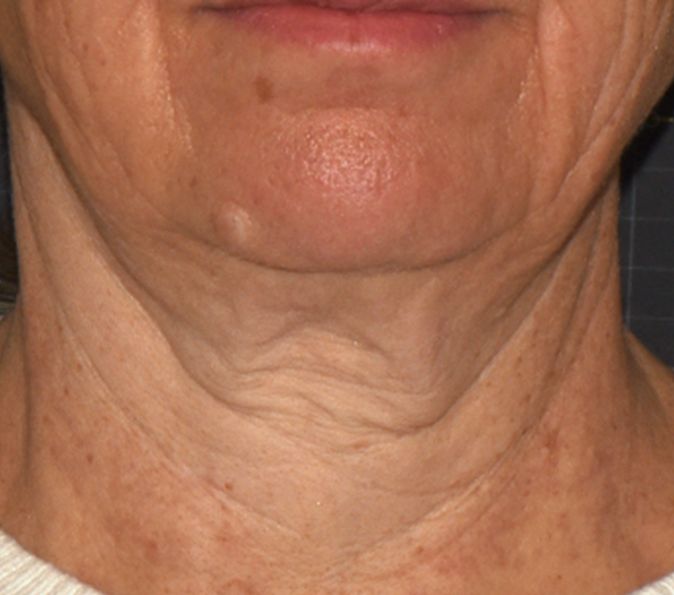 Before
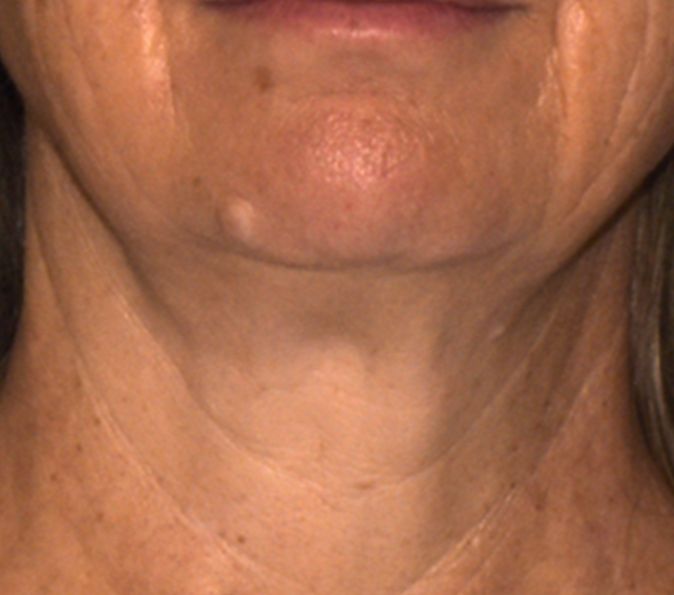 After
AfterWhat the research does not yet prove
The published Sofwave literature is growing, but many studies remain small, lack a randomized control group, or rely partly on photographic ratings. Some studies include manufacturer support or authors with industry relationships. Follow-up commonly extends for several months rather than multiple years.
That means research can support a reasonable biological mechanism and the possibility of gradual improvement in selected patients, but it cannot promise a specific millimeter of lift, guarantee duration, or tell us that Sofwave is automatically the best option for every person. Direct head-to-head research against other energy-based devices is still limited.
What should a patient expect?
A Sofwave visit begins with medical and aesthetic assessment, not with the handpiece. The provider should review health history, previous procedures, treatment area, degree of laxity, facial structure, comfort expectations, and whether another modality may better match the goal.
During treatment, patients commonly describe repeated pulses of heat or intensity. Integrated cooling is designed to protect the surface and support comfort, but published pain scores show that “non-invasive” does not always mean sensation-free. Redness or swelling may occur temporarily. Because collagen remodeling takes time, changes are generally assessed over weeks and months rather than immediately.
Who may be a reasonable candidate?
Current reviews describe ultrasound rejuvenation as most relevant for adults with mild to moderate laxity who want incremental improvement without surgery. Someone seeking substantial lifting, correction of significant volume loss, or treatment of a different skin concern may need a different—or combined—approach.
The right decision depends on anatomy, goals, medical history, and realistic expectations. Online information cannot determine candidacy. At Muse MedSpa, our Bellevue team uses an in-person consultation to explain the available options and create a plan around the individual rather than a device trend.
Sofwave in Bellevue
Explore the treatment,
then start with a conversation.
Muse MedSpa is recognized by Sofwave as the Pacific Northwest #1 Provider and is listed in the official provider directory. Learn about our technology, provider recognition, and treatment approach.
Visit our Sofwave service pageCommon questions
What patients often ask
Is Sofwave the same as focused ultrasound?
No. Sofwave uses high-intensity, non-focused parallel ultrasound beams targeted to the mid-dermis. Other ultrasound platforms may use focused energy at different depths. The appropriate technology depends on the treatment goal and anatomy.
How quickly should results appear?
Clinical studies commonly evaluate changes at one, three, or six months because collagen remodeling is gradual. Timing and degree of improvement vary from person to person.
Does Sofwave replace surgery?
No. Non-invasive ultrasound may offer incremental improvement for selected patients with mild to moderate laxity, but it does not reproduce the degree of correction possible with surgery.
Sources and further reading
- Evaluation of high-intensity non-focused ultrasound in Asian patients, Journal of Cosmetic Dermatology, 2026.
- High-intensity non-focused parallel ultrasound for facial laxity, Journal of Cosmetic Dermatology, 2023.
- Parallel-beam ultrasound at 1.5 mm for lower-face tightening, Journal of Cosmetic Dermatology, 2023.
- FDA 510(k) summary K233104, upper-arm laxity indication and consolidated indications for use.
- Use of ultrasound in face and neck rejuvenation, Facial Plastic Surgery Clinics of North America, 2026.
This article is for general education and is not medical advice, diagnosis, or a promise of outcome. Individual results and treatment experiences vary. A consultation with a qualified medical professional is required to assess risks, benefits, alternatives, and candidacy.