

Combination treatment can sound like “more is better.” In evidence-based aesthetic care, the better question is whether each technology addresses a distinct concern, whether the sequence is appropriate for the individual, and whether the expected benefit justifies the added time, cost, and risk.
Two technologies with different jobs
Thermage FLX: monopolar radiofrequency
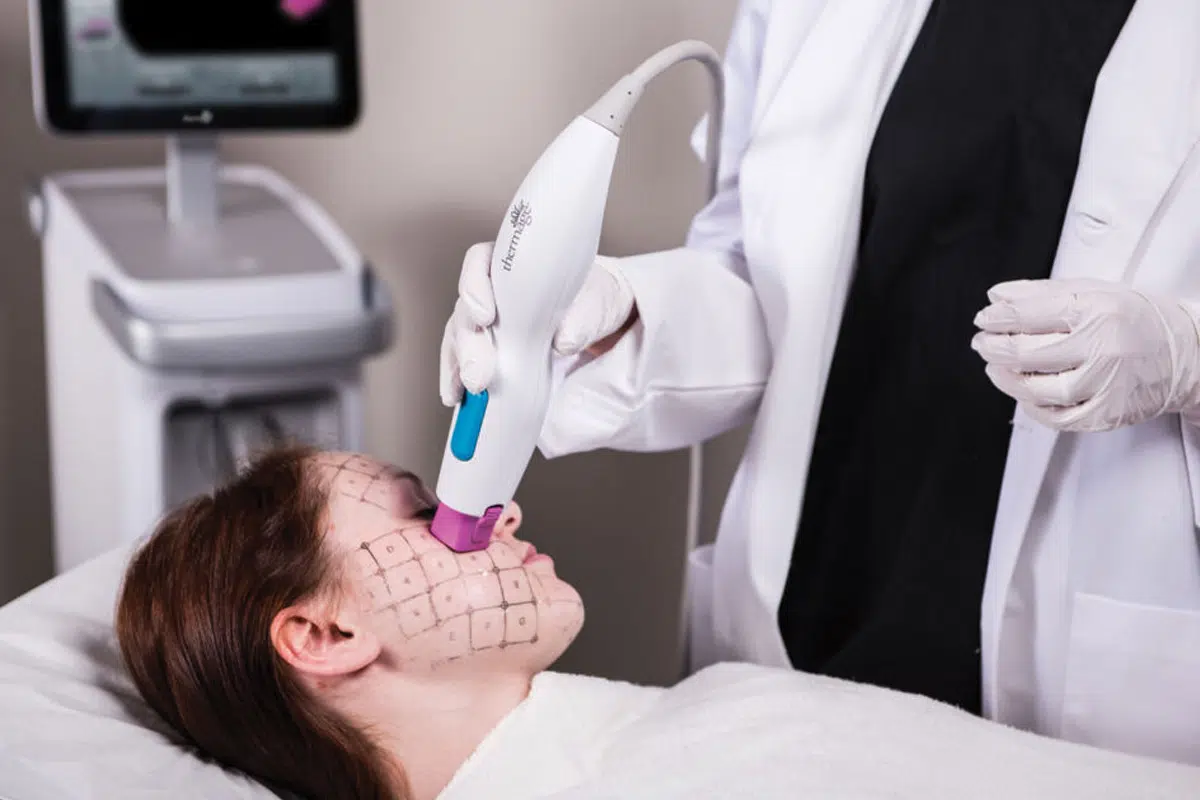
Thermage FLX uses monopolar radiofrequency energy. The FDA 510(k) summary describes the system as delivering RF energy while conductively cooling the epidermis and monitoring skin contact. Its cleared indications include non-invasive treatment of periorbital wrinkles and wrinkles and rhytids. The manufacturer describes gradual collagen remodeling, with visible changes that may continue to develop over several months.
In practical terms, Thermage is generally discussed when skin firmness, laxity, or contour is the central concern. It does not replace surgery, restore lost facial volume, or correct every cause of an aging appearance.
Clear + Brilliant: nonablative fractional laser
Clear + Brilliant creates microscopic treatment zones with a nonablative fractional laser while leaving surrounding tissue intact. It is generally used as a series for concerns such as early photoaging, uneven tone, and texture. Because it works differently from radiofrequency, it may be considered when a patient has both laxity-related and surface-quality goals.
The useful distinction
Combination treatment should solve more than one defined problem.
One device may be selected for firmness and another for pigment or texture, but that does not mean every patient needs both. A qualified provider should first separate the concerns, review skin type and medical history, and decide whether one treatment, a staged combination, or another approach is more appropriate.
What did the 2025 study examine?
A prospective, single-arm study published in Dermatologic Surgery enrolled 20 women with mild to moderate facial skin laxity and photoaging. Participants received one Thermage FLX treatment followed by four Clear + Brilliant Touch treatments using 1440-nm and 1927-nm wavelengths.
Researchers used clinical grading scales, blinded photographic review, and participant satisfaction measures. At six months, the investigators reported statistically significant improvements in skin-laxity and photoaging scores. Blinded reviewers correctly identified 67% of post-treatment photographs, and 77% of participants were categorized as responders.
The study is useful because it evaluated a real-world question: whether a sequence targeting deeper firmness and more superficial texture or pigmentation could produce a broader visible change. It also followed participants long enough to capture some of the gradual remodeling expected after radiofrequency.
What the study cannot prove
The research was small, included only 20 participants, and did not have a randomized comparison group. Because everyone received both technologies, the study cannot tell us how much improvement came from Thermage, how much came from Clear + Brilliant, or whether the combined sequence was superior to either treatment alone.
Participants were women selected for mild to moderate laxity and photoaging. The findings should not be generalized automatically to all genders, skin types, degrees of laxity, medical histories, or treatment goals. Photographic review and satisfaction measures are clinically useful but still differ from large, controlled trials with objective long-term endpoints.
Finally, a statistically significant average change does not predict one person’s result. Anatomy, baseline collagen, sun exposure, smoking history, hormonal changes, previous procedures, skincare, and the treatment plan can all influence the outcome.
How a personalized sequence is planned
1. Define the primary concern
If laxity is the main issue, the consultation should clarify whether non-invasive radiofrequency is likely to produce a meaningful degree of change. If pigmentation, roughness, or early photodamage is more prominent, a fractional laser plan may be prioritized. When both are present, combining modalities may be discussed.
2. Review skin type, timing, and recent procedures
Energy-based treatments require an accurate history. The provider should review medications, active skin conditions, implanted electrical devices, prior fillers or energy treatments, pregnancy or breastfeeding status, tendency toward pigment change, and upcoming sun exposure or events. The Thermage manufacturer specifically lists an implanted pacemaker, cardioverter, defibrillator, or other electrical implant as a contraindication and provides additional important safety information.
3. Decide whether treatments should be staged
The 2025 study used one radiofrequency treatment followed by a series of four fractional laser treatments. That research protocol is not a prescription for every patient. Sequence and spacing should be selected by the treating professional based on tissue response, treatment intensity, tolerance, and the patient’s priorities.
4. Set expectations before treatment
Thermage changes are generally assessed over months as collagen remodeling develops. Clear + Brilliant is commonly planned as a series, and temporary redness, warmth, swelling, dryness, or a sandpaper-like texture may occur depending on the treatment. Individual experiences and results vary.
Bellevue, Washington
Start with the concern,
not the device trend.
Muse MedSpa offers both Thermage FLX and Clear + Brilliant for Bellevue and Seattle Eastside patients. A consultation is used to review your anatomy, skin, goals, medical history, and whether one treatment or a carefully staged plan makes sense.
Common questions
What patients often ask
Do I need both Thermage FLX and Clear + Brilliant?
Not necessarily. The technologies address different aspects of skin aging. Some patients may be better served by one treatment, a different modality, or no procedure at all. An in-person evaluation is needed to determine whether a combination offers a reasonable benefit.
Can the treatments be performed on the same day?
Timing depends on the planned settings, treatment area, skin condition, medical history, and provider protocol. The published study used a sequence over time, but it does not establish one universal schedule. Your treating professional should determine timing.
Is Thermage FLX FDA approved?
Thermage FLX is an FDA-cleared Class II medical device through the 510(k) pathway for specified indications, including non-invasive treatment of periorbital wrinkles and wrinkles and rhytids. “Cleared” is the accurate regulatory term and does not guarantee an individual result.
How much downtime should I expect?
The Thermage manufacturer describes little to no downtime for many patients, although temporary redness, swelling, pain, and less common adverse effects are possible. Fractional laser recovery varies with wavelength, settings, and individual skin response. Your provider should explain the expected course for your exact plan.
Sources and further reading
- Peters JD et al. Combination Use of 1440-nm and 1927-nm Nonablative Fractional Laser With Monopolar Radiofrequency, Dermatologic Surgery, published online February 18, 2025.
- FDA 510(k) Summary K170758: Thermage FLX System, clearance letter dated September 22, 2017.
- Thermage FLX official patient information and important safety information, accessed September 28, 2026.
- Monopolar Radiofrequency-Induced Fibroblast Stimulation for the Prevention and Improvement of Skin Laxity, Dermatologic Surgery, 2025.
This article is for general education and is not medical advice, diagnosis, or a promise of outcome. Individual results and treatment experiences vary. A consultation with a qualified medical professional is required to assess risks, benefits, alternatives, and candidacy.