

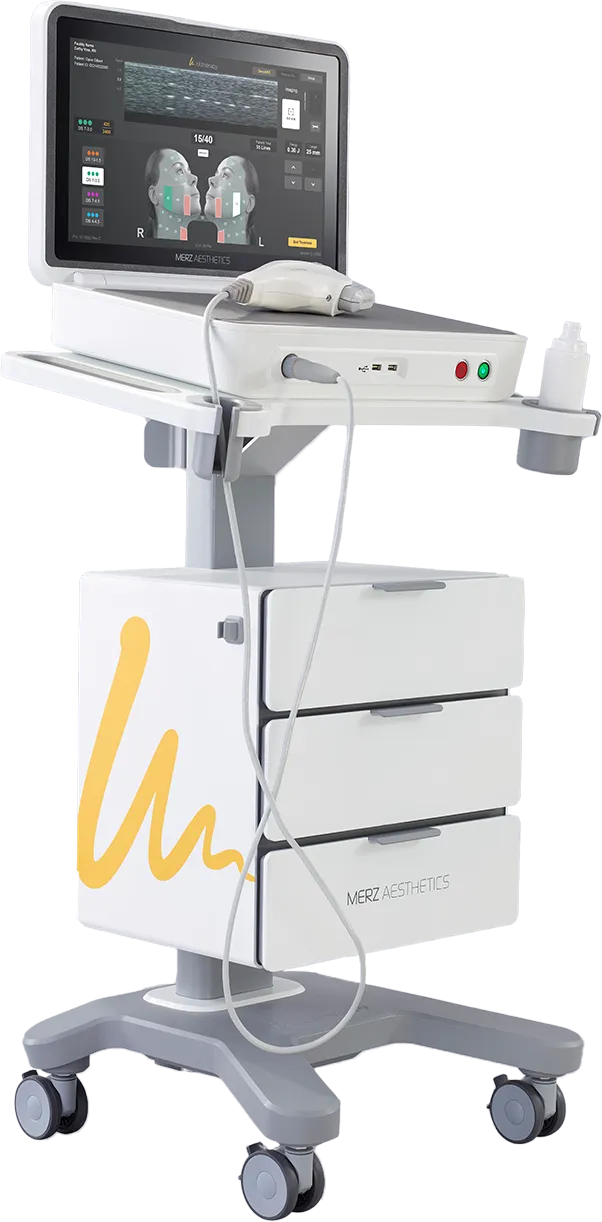
A device name alone does not determine a good result. For microfocused ultrasound with visualization—often abbreviated MFU-V—the treatment plan depends on anatomy, tissue depth, coupling, line placement, medical history, and whether a non-surgical degree of change fits the patient’s goal.
What is different about Ultherapy PRIME?
Ultherapy PRIME is the updated control platform for the Ulthera System. The FDA cleared the PRIME control unit in February 2024 through the 510(k) pathway. Like the earlier system, it integrates ultrasound imaging and treatment. The manufacturer’s instructions explain that imaging lets the provider visualize dermal and subdermal tissue, confirm contact with the skin, and identify the depth at which energy will be delivered.
The treatment component directs focused acoustic energy below the skin’s surface, creating discrete points of thermal coagulation. This initiates a wound-healing response associated with tissue remodeling. It is not surgery, does not remove excess skin, and should not be presented as equivalent to a facelift.
Why visualization matters
The provider can see before treating.
Real-time imaging is used to confirm tissue depth and transducer contact rather than relying only on a surface map. That does not make every treatment identical or risk-free. It makes careful assessment and technique central to planning.
What does the newer research show?
A 30-person Asian patient case series
A 2025 pilot case series followed 30 adults treated at three clinics in Singapore. Participants had mild-to-severe jawline and neck sagging and received customized, dual-depth Ultherapy PRIME treatment. At 90 days, 86.7% had at least a one-point improvement in the study’s neck-volume scale and 70% had at least a one-point improvement in the jawline scale. The mean reported pain score was 4.5 on a 0–10 scale.
This study is relevant to many Bellevue and Seattle Eastside patients because most participants were ethnically Chinese and had Fitzpatrick skin types III or IV. Still, it should not be treated as a prediction for any individual. The group was small, follow-up lasted only 90 days, there was no untreated or legacy-device control group, and assessments were not independently blinded. The program was sponsored by Merz Aesthetics, and the authors disclosed consulting relationships and honoraria.
A patient-reported comparison with the legacy platform
A separate 2025 survey study compared patient-reported pain, redness, and swelling after Ultherapy PRIME and legacy Ultherapy. It included 231 participants who had experience with both platforms and 92 who received PRIME as their first Ultherapy treatment. Participants reported less pain, erythema, and edema with PRIME.
That is encouraging, but the design matters: it was a single-center, unblinded questionnaire study without a randomized crossover design. Patient recall, expectations, treatment technique, analgesia, and differences in the treatment plan could all affect the answers. The study supports a conversation about comfort; it does not guarantee a painless procedure.
What broader safety literature adds
A 2025 systematic review evaluated 19 published reports covering 506 MFU-V patients and also reviewed voluntary FDA MAUDE reports. Temporary swelling, redness, and pain were the most common events in the published literature. The review found limited peer-reviewed evidence of serious events, but voluntary reports included fat loss, nerve-related symptoms, numbness, altered sensation, drooping, and scarring. Voluntary reporting cannot establish how often an event occurs or prove causation, yet it is a reminder that energy placement and patient selection matter.
What the evidence cannot tell us yet
The first Ultherapy PRIME clinical reports are not large randomized trials. They do not establish that PRIME produces more lifting than the legacy system, that every skin type or degree of laxity responds similarly, or that a particular number of treatment lines is appropriate for everyone.
They also do not answer every long-term question. The 30-person case series evaluated outcomes at 90 days. Larger studies with independent blinded assessment, standardized comfort protocols, diverse participants, comparison groups, and longer follow-up would make the evidence more useful.
Safety, side effects, and candidacy
The current U.S. instructions list temporary redness, swelling, welting, discomfort, tenderness, bruising, and transient nerve effects among possible face and neck effects. Post-market reports also include less common but potentially serious outcomes such as burns, pigment change, scarring, fat or volume loss, prolonged nerve symptoms, and asymmetry.
The system is contraindicated over open wounds or lesions, severe or cystic acne in the treatment area, active implants such as pacemakers or defibrillators, and metallic implants in the treatment area. The instructions also identify precautions involving fillers, anticoagulant therapy, pregnancy or breastfeeding, certain health conditions, and anatomical areas that should be avoided. This is why candidacy cannot be decided from an online article.
How Muse approaches planning in Bellevue
1. Clarify the kind of change you want
Ultherapy PRIME is generally discussed when the goal involves a non-surgical lift of the brow, tissue beneath the chin, or the neck, or improvement of lines and wrinkles on the décolleté. Marked skin excess, volume loss, muscle activity, pigmentation, or surface texture may require a different conversation.
2. Review anatomy and treatment history
A consultation should cover prior energy treatments, fillers, surgery, implants, medications, medical conditions, sensitivity, comfort preferences, and the timing of upcoming events. The provider then determines whether treatment is reasonable and which tissue depths and areas should be considered.
3. Set expectations around timing
Because the intended response involves gradual tissue remodeling, results are not judged immediately. Some patients notice early change, but meaningful assessment is generally made over the following months. Individual results, comfort, recovery, and longevity vary.
Bellevue · Seattle Eastside
See the anatomy.
Plan the treatment.
Muse MedSpa offers Ultherapy PRIME with real-time visualization in Bellevue. A consultation is used to review your goals, medical history, anatomy, prior treatments, and whether a non-surgical ultrasound treatment is a reasonable fit.
Common questions
What patients often ask
Is Ultherapy PRIME FDA approved?
The Ulthera System is an FDA-cleared Class II medical device through the 510(k) pathway. “Cleared” is the accurate regulatory term. Cleared indications include lifting the eyebrow and lax tissue beneath the chin and on the neck, and improving décolleté lines and wrinkles. Clearance does not guarantee an individual result.
Is PRIME pain-free?
No treatment should be promised as pain-free. Newer patient-reported research found lower discomfort with PRIME than with legacy Ultherapy, but comfort varies with anatomy, treatment area, settings, technique, line count, and pain-management plan.
Does Ultherapy PRIME melt facial fat?
The device is designed to deliver energy at selected tissue depths, not as a facial fat-removal treatment. However, fat or volume loss appears in post-market safety reporting. Real-time imaging, appropriate patient selection, anatomical knowledge, and correct technique are important risk-management considerations.
How many sessions are needed?
Ultherapy is commonly discussed as a single-session treatment, but the appropriate plan and whether future treatment is considered depend on the individual, baseline laxity, goals, response, and provider assessment.
Is it appropriate for every degree of sagging?
No. Non-surgical ultrasound may be more suitable for selected patients seeking a gradual, limited lift. Significant skin excess or expectations closer to a surgical result require a different discussion and may warrant referral to a qualified surgeon.
Sources and further reading
- FDA 510(k) K233996: Ulthera System, UC-1 Control Unit PRIME, decision dated February 22, 2024.
- Lim J, Siew TW, Xu Y. Early Experience With Ultherapy Prime in Asia Pacific: A Pilot Case Series, Plastic and Reconstructive Surgery Global Open, 2025.
- Pain, Erythema, and Edema After Facial Lifting With Ultherapy Prime or Ultherapy Legacy—A Survey Study, Journal of Cosmetic Dermatology, 2025.
- Microfocused Ultrasound With Visualization: A Systematic Review of Adverse Events and Risk of Subsequent Facelift Compromise, Dermatologic Surgery, 2025.
- Ulthera System: U.S. Instructions for Use for Ultherapy PRIME, accessed October 5, 2026.
This article is for general education and is not medical advice, diagnosis, or a promise of outcome. Individual results and treatment experiences vary. A consultation with a qualified medical professional is required to assess risks, benefits, alternatives, and candidacy.